 Back
Back
January 05, 2026
RiConnect
By RiConnect
Share:


Site compliance assessments represent critical moments where occupational safety and health (OSHA) and health, safety, and environment (HSE) managers must verify that operations meet regulatory standards, safety protocols remain effective, and risk controls function as intended. Whether conducting internal audits, preparing for regulatory inspections, or verifying contractor compliance, these assessments determine organizational safety standards and regulatory exposure.
However, traditional site compliance assessment approaches create significant challenges that compromise assessment quality, consume excessive resources, and leave organizations vulnerable to undetected compliance gaps. Understanding these issues is essential for HSE managers tasked with maintaining robust safety oversight while managing operational demands.
After exploring these shortfalls, we shine a light on how RiConnect transforms site compliance assessments and provides complete visibility, even in the most demanding of industries.
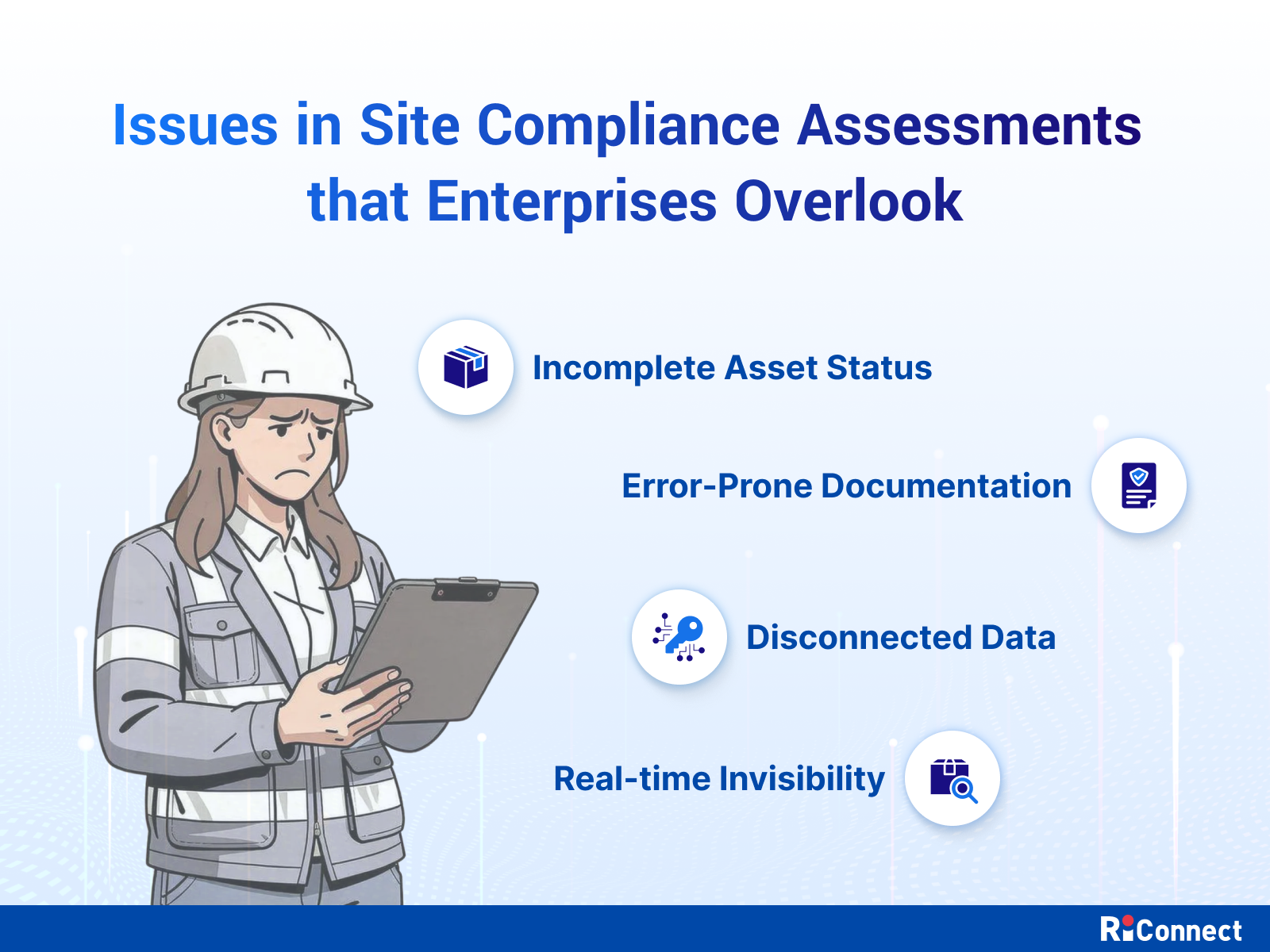
Effective compliance assessments require comprehensive preparation, yet many organizations struggle to gather necessary documentation before site visits begin. Equipment certification records scatter across multiple filing systems. Inspection histories exist in various formats from different contractors. Training records lack centralization. Maintenance logs remain incomplete or inaccessible.
This documentation chaos forces assessment teams to spend valuable on-site time searching for basic compliance evidence rather than conducting meaningful safety evaluations. Critical equipment may lack readily accessible proof of certification. Safety systems might have unclear maintenance histories. The inability to quickly verify compliance status extends assessment durations and reduces examination thoroughness.
During site visits, assessment teams face practical challenges gathering compliance evidence. Paper-based systems require manual transcription of equipment identifiers, inspection dates, and certification details—a time-consuming, error-prone process. Photographing equipment nameplates and certificates provides documentation but creates disconnected image files requiring post-assessment organization and analysis.
Equipment in remote site locations, elevated positions, or hazardous areas presents access challenges. Assessors may struggle to physically verify compliance for assets in difficult-to-reach locations. High-value equipment spread across large facilities makes comprehensive assessment within reasonable timeframes difficult without systematic tracking.
Multi-contractor sites present unique assessment challenges. Contractor-owned equipment operating on-site may lack clear compliance documentation. Third-party inspection companies provide certificates in varying formats with inconsistent detail levels. Equipment moving between contractors and locations loses compliance visibility.
HSE managers need to verify that contractor personnel possess current safety training, contractor equipment maintains valid certifications, and contractor safety procedures align with site requirements. Traditional paper-based verification processes cannot keep pace with dynamic contractor populations and equipment pools.
Static documentation creates uncertainty about current compliance status. A certificate from six months ago confirms historical compliance but doesn't verify current equipment status. Items could have been damaged, modified, or moved since last documented inspection. Critical safety systems might have undergone testing or maintenance, affecting their compliance standing.
Assessment teams need confidence that documented compliance reflects actual current conditions. The gap between documentation dates and assessment dates creates uncertainty that undermines assessment reliability and regulatory confidence.
Identifying non-compliances during assessments is only the first step. The real challenge lies in maintaining visibility of remediation progress and ensuring sustained compliance after assessments conclude. Traditional approaches struggle with status tracking once assessment teams leave the site.
Non-compliance findings documented in assessment reports often become static records with limited visibility into correction progress. HSE managers lack real-time awareness of which findings remain unresolved, which are in progress, and which have been completed. Without continuous status monitoring, critical findings may go unaddressed while management assumes progress is being made.
Follow-up assessments to verify corrections consume additional resources and often get delayed by operational priorities, creating extended periods where compliance status remains uncertain.
Organizations operating multiple facilities face coordination challenges conducting consistent assessments across sites. Assessment teams need to apply consistent standards, share findings, and identify systemic issues affecting multiple sites. Traditional site-by-site approaches make cross-site analysis difficult and miss opportunities for organization-wide improvement.
Compliance performance comparisons between sites, trending analysis across locations, and corporate-level compliance reporting all require consolidated data that scattered site-specific documentation cannot readily provide.
When regulatory agencies conduct inspections or incidents trigger investigations, organizations must produce comprehensive compliance evidence. Traditional documentation systems struggle to quickly generate complete audit trails showing equipment inspection histories, training records, and safety system verification.
The inability to rapidly demonstrate compliance during regulatory interactions creates unnecessary exposure. Extended document retrieval times suggest poor compliance management even when actual compliance is adequate. Incomplete or unclear documentation trails raise regulatory concerns and increase scrutiny.
RiConnect transforms site compliance assessments through integrated digital compliance management designed specifically for HSE managers requiring comprehensive, efficient assessment capabilities.
Before site visits begin, RiConnect provides complete compliance visibility. HSE managers review equipment certification status, identify upcoming inspection deadlines, and flag potential non-compliances from their office. Assessment teams arrive on-site with clear understanding of compliance landscape, enabling focused investigation of areas requiring attention rather than general documentation gathering.
Assessment planning becomes data driven. High-risk equipment lacking recent inspection receives priority attention. Systems with compliance concerns get detailed evaluation. Resources focus where they create most value.
During site assessments, mobile devices enable instant equipment verification. Assessors scan radio-frequency identification (RFID) tags or QR codes on equipment to access complete compliance histories. Current certification status, last inspection date, testing results, and maintenance records appear immediately. Non-compliances are identified and documented digitally on-site.
Equipment in remote or difficult-to-access locations maintains digital accessibility. Assessors verify compliance without physical access challenges. Large facilities are assessed systematically without missing equipment or creating documentation gaps.
RiConnect maintains compliance visibility across organizational boundaries. Contractor-owned equipment operating on-site displays current certification status. Third-party inspection results automatically update equipment records. Contractor personnel training certifications are verified digitally.
Multi-contractor sites maintain unified compliance oversight. Equipment moving between contractors retains compliance history. HSE managers verify contractor compliance without manual documentation collection and verification.
Digital systems eliminate gaps between documentation and reality. Compliance status updates reflect recent inspections, maintenance activities, and equipment modifications. Assessment teams verify current conditions rather than historical compliance, providing confidence that findings accurately represent actual site conditions.
Automated alerts notify relevant personnel when compliance status changes. Equipment requiring attention is flagged immediately. HSE managers maintain continuous compliance awareness rather than discovering issues during scheduled assessments.
Non-compliance findings automatically generate corrective action tasks with assigned responsibilities and deadlines. HSE managers track correction progress, receive completion notifications, and verify remediation. Follow-up assessments focus specifically on previously identified issues rather than general re-assessment.
Corrective action effectiveness is monitored systematically. Recurring issues are identified and addressed. Compliance improvements are measured quantitatively rather than anecdotally.
Multi-site organizations gain consolidated compliance oversight. Corporate HSE managers compare performance across facilities, identify systemic issues, and track organization-wide compliance trends. Regulatory reporting pulls from comprehensive digital records rather than manual site data aggregation.
Best practices identified at one site are shared across the organization. Compliance performance benchmarking drives continuous improvement. Corporate compliance culture strengthens through transparent performance visibility.
When regulators arrive, comprehensive audit trails generate instantly. Equipment inspection histories, training records, safety system testing, and incident documentation is all accessible within minutes. Regulatory interactions proceed efficiently with confident compliance demonstration rather than uncertain documentation retrieval.
ISO 27001-certified information security ensures compliance data integrity and confidentiality. Tamper-evident audit trails provide credibility during regulatory scrutiny. Digital documentation satisfies regulatory requirements while supporting operational efficiency.
Effective site compliance assessments protect workers, satisfy regulators, and support operational excellence. RiConnect's digital approach transforms assessments from resource-intensive exercises into efficient, comprehensive evaluations that provide actionable intelligence for safety improvement.
For OSHA and HSE managers responsible for organizational safety oversight, digital compliance assessment capabilities represent strategic investment in regulatory confidence, operational efficiency, and most importantly, worker protection. When compliance assessments drive continuous safety improvement rather than merely checking regulatory boxes, organizations build safety cultures that prevent incidents rather than just document procedures.


