 Back
Back
December 01, 2025
RiConnect
By RiConnect
Share:


RiConnect, Inc. has shared the concept of Digital Product Passports as a Service (DPPaaS), aligning with the European Union’s Ecodesign for Sustainable Products Regulation (ESPR), which aims to improve the sustainability of products placed on the EU market. It will take effect in 2026.
DPPaaS supports customers by providing Digital Product Passports (DPPs) in a more accessible and cost-effective way, through a new Software as a Service (SaaS) model. RiConnect’s DPP architecture is also officially granted a patent in Taiwan, further validating the uniqueness and technical strength of its approach to digital compliance. This recognition reinforces the platform’s credibility as a trusted solution for global manufacturers preparing for next-generation sustainability requirements.
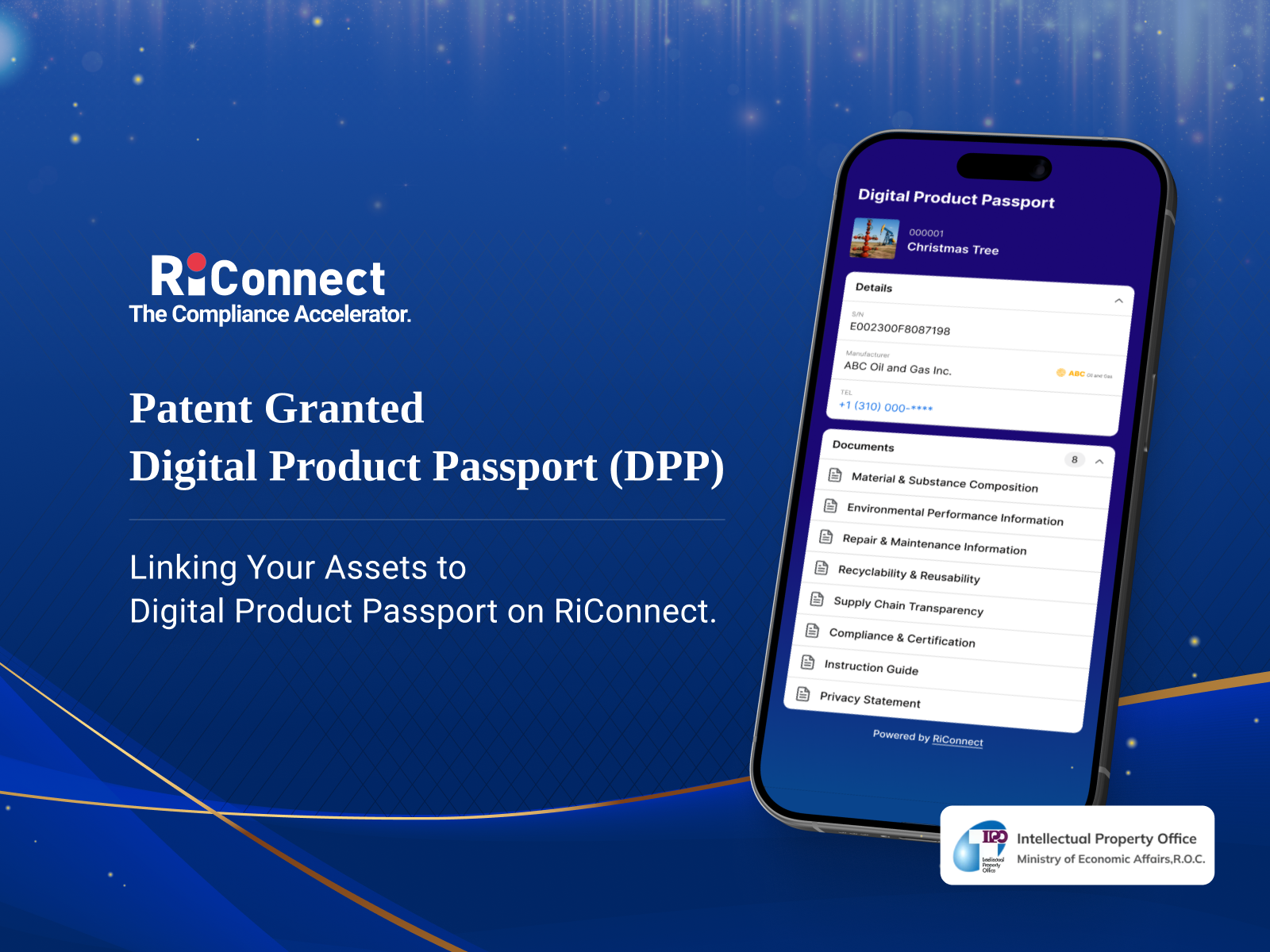
Powered by its cloud-based architecture, RiConnect significantly lowers the barrier to entry for companies that would otherwise have to build complex systems themselves. It not only ensures real-time synchronization with evolving EU regulations but also enables businesses of all sizes to rapidly deploy traceability solutions, turning regulatory obligations into operational advantages.
As global sustainability regulations continue to evolve rapidly, RiConnect demonstrates that digital transformation in compliance is not only achievable but also practical and scalable.
A Digital Product Passport (DPP) is a digital record that captures key information about a product throughout its entire lifecycle. From raw material sourcing and manufacturing, to usage, maintenance, and end-of-life handling, every essential stage is documented and traceable.
Just as a passport identifies a person and records their movements, a DPP identifies a product and chronicles its entire life—its materials, origin, energy usage, maintenance history, repair activities, and recycling or disposal instructions.
Unlike traditional paper certificates that are easily lost, outdated, or fragmented, a DPP is a dynamic digital record accessible through a QR code. Manufacturers, suppliers, operators, and end users can retrieve accurate and up-to-date information whenever needed. Each QR code corresponds directly to a product’s DPP.
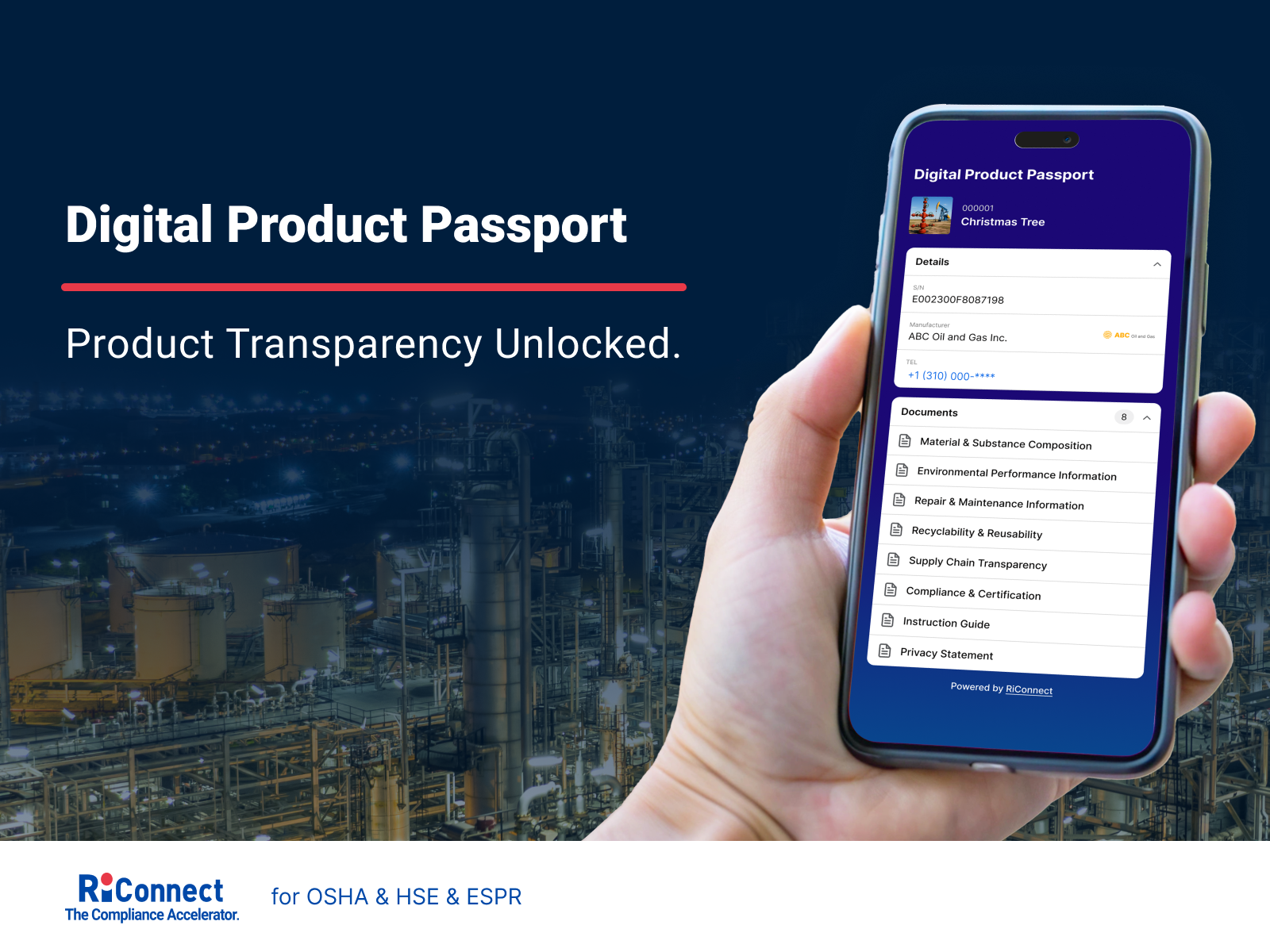
A typical DPP includes the following categories:
1. Material & Substance Composition
Details of materials, chemical components, their sources, associated environmental impacts, and regulatory compliance.
2. Environmental Performance Information
Energy consumption, carbon emissions, environmental indicators, and sustainability performance during manufacturing and use.
3. Repair & Maintenance Information
Maintenance procedures, repair guidelines, spare parts, technical manuals, and information that helps extend product lifespan.
4. Recyclability & Reusability
Recyclable materials, disassembly steps, reuse potential, and proper end-of-life handling instructions.
5. Supply Chain Transparency
Supplier data, material traceability, and manufacturer information to ensure transparency across the value chain.
6. Compliance & Certification
Safety standards, regulatory documents, certifications, testing records, and conformity assessments.
7. Instruction Guide
User instructions, operational guidelines, safety precautions, and best-practice recommendations.
8. Privacy Statement
Information on data handling, privacy protection, and user data management.
1. Regulatory Drivers
Beginning in 2026, the EU’s ESPR will officially require DPPs for nearly all physical goods (excluding food, feed, and medicine).
Products without a compliant DPP may be denied access to the EU market, directly impacting global trade and supply chains.
2. Environmental Needs
With climate change and resource scarcity intensifying, DPPs support the shift toward a circular economy.
DPPs enable products to be repaired, remanufactured, refurbished, or recycled—keeping materials in circulation rather than becoming waste.
With DPPs:
3. Business Advantages
The benefits of DPPs extend well beyond regulatory compliance.
A transparent supply chain builds trust.
Comprehensive documentation strengthens warranty and after-sales support.
Sustainability information helps products stand out in increasingly competitive markets.
Early adopters gain a significant competitive edge as industries transition toward full lifecycle transparency.
The traditional approach of “produce, use, discard” is no longer sustainable.
DPPs enable a circular model by supporting repair, refurbishment, remanufacturing, and recycling.
This shift depends on complete and accurate product information, which the DPP provides.
Supply chains have long suffered from limited visibility. DPPs close these information gaps, enabling more responsible manufacturing and informed purchasing decisions.
Paper documents expire, are lost, or fail to reflect updates. DPPs evolve with the product, capturing inspections, maintenance, repairs, and updates in real time. This improves asset management precision and enables targeted product recalls.
Organizations used to scramble to gather documents before audits. With DPP, compliance information is maintained continuously, reducing audit preparation from weeks to minutes.
Digital Product Passports represent more than a regulatory requirement. They redefine how society views products. Products are not disposable commodities, but assets that require responsible management throughout extended lifecycles.
As ESPR becomes the global benchmark and other regions follow, DPPs will evolve into a universal standard for product information management.
Companies that adopt DPPs early will be at the forefront of this shift toward sustainability and transparency.
RiConnect, with its DPPaaS model, proves that DPP adoption does not need to be difficult or costly.
Organizations of any size can join the DPP movement through RiConnect, turning compliance obligations into operational advantages and transforming sustainability commitments into true competitive differentiation.
With the 2026 regulation approaching, now is the optimal time for businesses to evaluate their product transparency strategies. RiConnect's DPPaaS is the ideal partner for your journey into the new era of global sustainability and compliance—keep asset data accurate, strengthen operational visibility, and ensure every record truly reflects real-world conditions.


